




















Machine Man Word Cloud
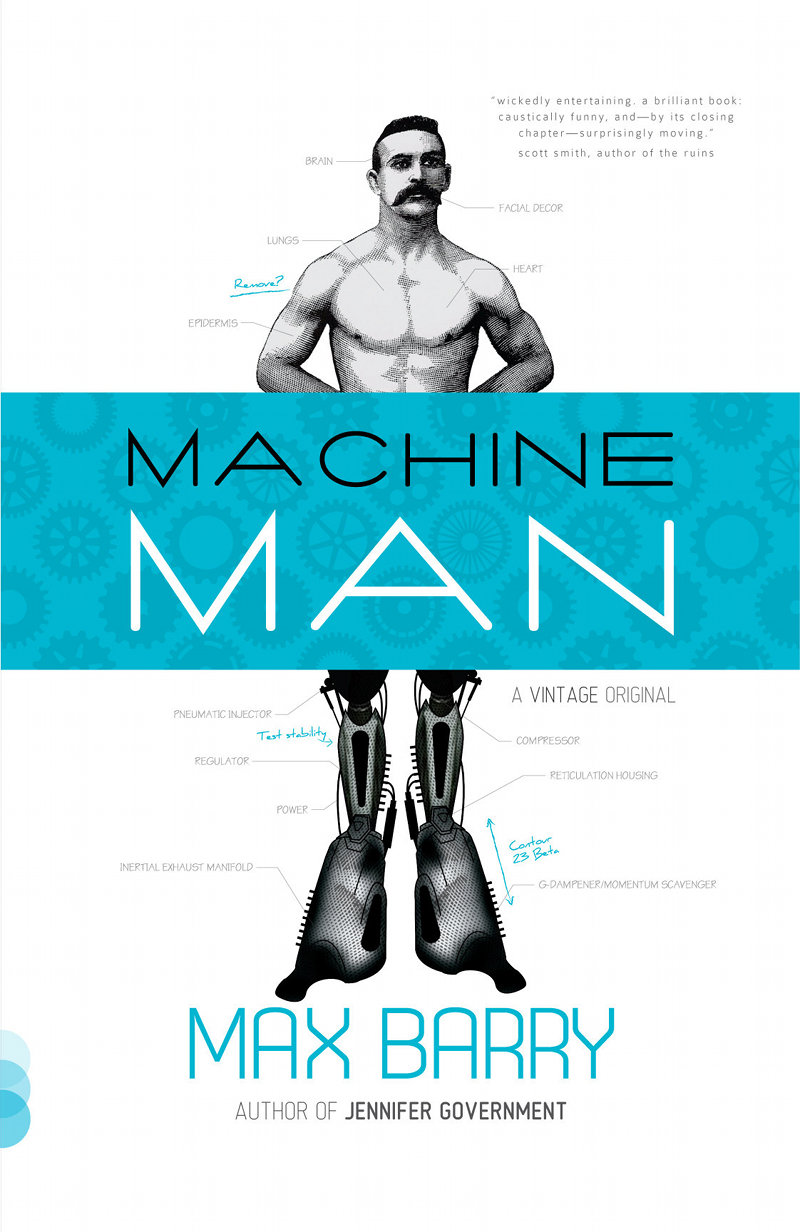
 I discovered a word cloud generator, so naturally enough I pasted
Machine Man into it.
I discovered a word cloud generator, so naturally enough I pasted
Machine Man into it.
It looks like this:
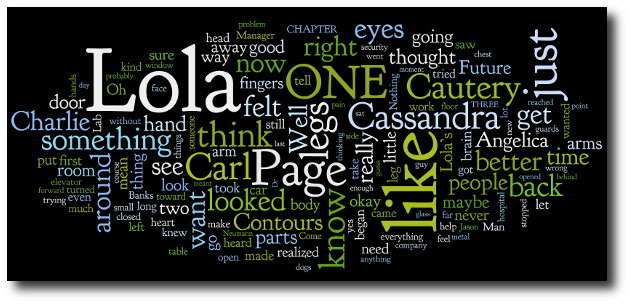
Image courtesy wordle.net
That’s pretty awesome. I love the big Lola. I’m disappointed “just” is so big, though. I have to stop using that. Possibly I am overdoing the similes, too, with a “like” of those dimensions. But the scattering of body parts is nice.
 14 comments
Big Brother Is Actually Not Watching You At All

 Nine
girls were trapped in a big house in Turkey, their every move filmed
for the titalation of their captors. Not recently. This was about a month ago. I’m
only mentioning it now because a month ago
my brain wasn’t working. Back then,
I just thought, “That… irony… blog.” That’s as far as I got. But I’m feeling better now,
thanks for asking.
Nine
girls were trapped in a big house in Turkey, their every move filmed
for the titalation of their captors. Not recently. This was about a month ago. I’m
only mentioning it now because a month ago
my brain wasn’t working. Back then,
I just thought, “That… irony… blog.” That’s as far as I got. But I’m feeling better now,
thanks for asking.
So the interesting part is that the girls thought they were on Big Brother. According to reports:
…the women were not abused or harassed sexually, but were told to fight each other, to wear bikinis, and to dance by the villa’s pool.
Upon discovering this was not for a national TV audience but just a couple of horny old men who owned the house (I’m guessing), the girls reacted badly. Apparently they demanded to be released. But they’d signed contracts, promising to stay for at least two months, and the contracts had some pretty serious penalty clauses: tens of thousands of dollars if the girls left early. I guess you call that a pay or play deal.
The girls took the position they’d been duped, so they were essentially being kidnapped. When the police found out, they agreed.
Me, I’m not so sure. It seems the girls’ main objection is that while they were wearing bikinis, dancing by the pool, and talking about their most embarrassing sexual experiences (I’m guessing), not enough people were watching. These degrading, exploitative acts they were pressured to perform, they weren’t broadcast on prime-time. The problem was there was no fame. The mother of one of the girls said:
We were not after the money but we thought our daughter could have the chance of becoming famous if she took part in the contest. But they have duped us all.
Being watched by two sleazy guys wasn’t enough. If it were millions of sleazy guys, that would be okay. But two? That’s sick.
Zombies Are For Grown-Ups: Why Banning Video Games Makes Them More Violent
 I’m
a parent. I also like to slay zombies. Lately, my wife and I have spent
nights side-by-side, mowing down hordes of gibbering undead with automatic
weapons. Sometimes we blow them up with pipe bombs, or set them on fire.
We don’t go looking for them. They rush at us out of darkened city alleys.
They break through doors. It’s us or them.
I’m
a parent. I also like to slay zombies. Lately, my wife and I have spent
nights side-by-side, mowing down hordes of gibbering undead with automatic
weapons. Sometimes we blow them up with pipe bombs, or set them on fire.
We don’t go looking for them. They rush at us out of darkened city alleys.
They break through doors. It’s us or them.
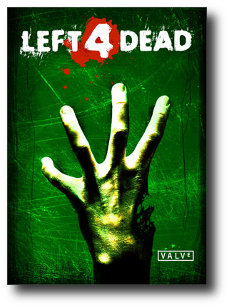
I’m talking of course about the computer game Left 4 Dead. It has a sequel, due out next month, which looks similar—so similar, in fact, there is a protest by Left 4 Dead fans that it should be a free update, not a new full-price game. The main difference seems to be that it has hand weapons, inviting players to bludgeon zombies with baseball bats, chop them up with axes, and dismember them with chainsaws.
This was too much for the Australian Classifications Board, which ruled that the game’s “unrelenting violence” was “unsuitable for a minor to see or play.” Of particular concern were those hand weapons, which:
…cause copious amounts of blood spray and splatter, decapitations and limb dismemberment, as well as locational damage where contact is made to the enemy which may reveal skeletal bits and gore.
Australia has no adults-only classification for video games: all games must be qualify for MA15+ or lower to be allowed on sale. (We are, apparently, the only developed democracy in the world without an 18+ category for games.) The chief advocate of this position is South Australian attorney general Michael Atkinson, who responded to the banning of Left 4 Dead 2 by saying: “It certainly does restrict choice to a small degree, but that is the price of keeping this material from children and vulnerable adults. In my view, the small sacrifice is worth it.”
I’m not quite sure what he means by “vulnerable adults.” Possibly Atkinson thinks there is a class of grown-ups who really aren’t: who should be treated like children their entire lives. Possibly this class includes adults who like to play video games.
But that’s not the point. The point is what happened next: the game developer, like other developers before it, deleted some of the gorier parts and resubmitted it. The Australian Classifications Board noted that “large and frequent blood splatters are seen,” but now “dead bodies and blood splatter disappear as they touch the ground.” You can still rip zombies to pieces with a chainsaw, but “no wound detail is shown.” It was awarded an MA15+ classification (meaning 14 year olds and younger require a guardian present), tagged: “Strong bloody violence.”
Instead of Australia having a violent, bloody computer game restricted to adults, it will have a violent, not-quite-as-bloody game on sale to children. This is the effect of our law: to take content that was designed for adults and tweak it until it scrapes under the MA15+ bar. We’re making available to children material they would not otherwise see, clustered at the extreme end of what is acceptable.
Left 4 Dead comes with a developers’ commentary audio track, like a DVD. (The industry has grown up: popular titles cost as much to produce as blockbuster films, are promoted as heavily, and generate as much revenue, or more.) You can hear the designers describe how they used sound, light, and dramatic techniques to create an atmosphere of dread. How each zombie has a unique face and behavior: sometimes they wander around, or sit, or put their faces in their hands and sob. When they die, their flailing movements are based on a motion-captured stunt man, to look more realistic.
We need to worry less about 15-year-olds seeing “wound detail” and more about immersing them in an environment of unmitigated horror. The most shocking films and books are not merely graphic, they are suggestive. Even the most explicit horror movies chill primarily not because of what they depict, but what they might. Any storyteller knows: the monster is scarier before it’s revealed. There is more to terror than blood.
So far this debate has been framed as an argument between protecting children and upholding adults’ freedom of choice. We’re doing neither.
A Short Story Broke My Brain

 You
might be wondering what happened to
that live short story. I did it.
I just haven’t written about it because I lost the ability to form coherent sentences.
You
might be wondering what happened to
that live short story. I did it.
I just haven’t written about it because I lost the ability to form coherent sentences.
I knew it would be tough. Turning up at the Melbourne Writers Festival with a laptop, plugging into the big screen, and writing a short story from scratch while people watch: that’s not the recommended writing technique. I think that’s the opposite of what you’re supposed to do, which is something about forgetting the rest of the world exists. It’s hard to be creative and self-conscious.
But that was half the fun! Come watch Max struggle! I was already writing an online serial in real-time; how much worse could this be?
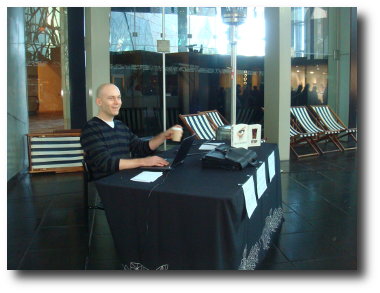
Lots. I turned up on the day, ready for action, at the table they’d set up. It was in the corner of the atrium, hidden behind the Festival’s Information Desk. On official maps, you couldn’t see it, because it was obscured by the word “INFORMATION.” This struck me as problematic. There was no signage to indicate who I was or what I was doing. Shortly after I began to set up, a man stopped and asked for directions to a panel. I decided it was time to make up my own signs. I did three, and stuck them to the front of the table: the first said, “Hi! I’m Max Barry.” The second said, “I’m writing a live short story today.” The third said, “Because I’m stupid, that’s why.” This turned out to be truer than I knew.
Half a dozen people had gathered. About this number stayed the entire three hours, and may I say to those people, I’m incredibly touched and grateful, even though you destroyed my sanity. There was nowhere for them to comfortably see the screen and me at the same time, but that didn’t deter them; oh no. They made the best of things, craning their necks and reclining chairs like they were beach lounges. That way, they could see pixelated, perspective-warped words on the big screen while staying close enough to make out the individual beads of sweat dripping down my nose.
But I’m getting ahead of myself. First I had to chase down Festival people, imploring somebody to plug me into the big screen like we had damn well arranged. I hate to knock the Festival, because it’s a great event, but this was really crap. People were waiting.
Once I was on the air, I canvassed my little audience for ideas. I got some great ones, some good ones, and some I still don’t understand today. The two that jumped out at me were both about pregnancy: one about a couple whose due date comes and goes, and goes and goes, and another about renting a baby. In retrospect, I probably should have been wary of both of these, because they’re similar to two other shorts I’ve written: How I Met My Daughter and A Shade Less Perfect. I was already defensive, feeling around for tried and tested tools.
But it was only 11:30am: I was full of energy, optimistic! When people came up and asked for directions, I tried to help them out, then went back to my notes. Sometimes I asked for feedback from the people standing around. Then I realized I didn’t have to: I could hear their reactions.
Let me say that again. I would type a sentence, and hear people inhale, or snicker, or lean together to discuss it. Now, I guess I knew this might happen. And, at first, while I was messing around with notes, it was funny. Even useful. But then I started writing. And it was like they were INSIDE MY BRAIN.
The longest I ever sunk into the story before remembering that people were watching was about 45 seconds. Often I would be halfway through a sentence and someone would stop by to chat or offer suggestions or ask where the bathrooms were. Which is what I signed up for, of course: this was meant to be interactive. But it was like being woken from a deep sleep eighty times an hour. Two parts of my brain that don’t normally meet were knocking into each other and I wasn’t sure which of them was me.
By the two-hour mark, I was flagging. The story wasn’t awful, but it didn’t feel right. It was derivative, of me; like something not new. I wasn’t connected to it. I had honestly tried to do this right, but if I’d been at home, at this point I would have closed the document and checked my email.
Since that would have been inappropriate with an audience, I ploughed on. At 2pm, I finished. I thanked everyone who had stuck around, and I meant it, even though I already knew I would be spending the next few days trying to scrub them out of my brain. Then I left. I felt like someone had beaten the creative part of my mind with sticks. The rest of the day, I struggled to talk like a human being. True, I have that problem normally. But this was even worse than usual.
The next time I sat down in my study, I felt them there: phantom story-watchers. Halfway through my first sentence, I almost braced for a snicker. But it didn’t come. After a while, I forgot about it. I was okay. I was safe again.