

































Allevia: So Sue Me
 The other day two people threatened to sue me. Admittedly, they were employees
of the same company. But still: two in 24 hours is a new record for me.
It’s also the first time I’ve been threatened by a company,
not an individual. But, like all the others, it was related to
NationStates,
the nation simulation web game I wrote.
The other day two people threatened to sue me. Admittedly, they were employees
of the same company. But still: two in 24 hours is a new record for me.
It’s also the first time I’ve been threatened by a company,
not an individual. But, like all the others, it was related to
NationStates,
the nation simulation web game I wrote.
To whom it may concern:
There is a “counrty” on your webite called “Allevia”. Allevia is a TRADEMARKED name and may not be used on your website. You will be receiving registered mail shortly from our legal councel here in Switzerland. We advise that you remove the trademarked name from your site without delay.
Sincerely,
N. Jackson
At first I thought this was a stunt by a NationStates player, trying to get the Allevia nation into trouble—because players can be devious like that. But there is a real Swiss company called Allevia, so I wrote to them to ask if this was for real.
Before long I had a reply from Pierre Mainil-Varlet, MD, PhD, MBA, Allevia’s Chief Operating Officer. Pierre confirmed it was genuine, and if I didn’t scrub Allevia from NationStates, “a legal action will be started.”
Now I was confused. It’s not like Allevia is such a bad nation. It’s a democracy, has excellent civil rights, low unemployment, and its national animal was the Tufted Penguin. Those are some cool birds. Sure, it’s a corporate bordello, but whose country isn’t, these days? So I had trouble seeing what this company’s problem was—other than the fact that Google’s “allevia” results listed someone who wasn’t them at number five.
I wrote to Pierre expressing my doubts:
Could you please explain why you believe the use of the Allevia name by one of our players is illegal? To my eye it just looks like coincidence—nothing about the account suggests the player is referring to (or even aware of) your company. Should nationstates.net be in breach of the law, then by all means we will comply, but I’m a little puzzled about what law you think is being broken here.
Pierre fired back a very interesting reply. Before I reveal that, though, here is a quiz. Imagine you discover an unrelated use of your company’s name in an obscure online computer game. There’s nothing offensive or damaging about it, but still, it bugs you that the internet isn’t reserved solely for your marketing messages. What do you do?
Your options:
- Ignore it, because it has nothing to do with you, and your time is better spent doing whatever the hell it is that your company is supposed to do.
- Write a polite letter explaining the situation, keeping in mind that in many parts of the world, including all the relevant ones, threatening legal action over a trademark without a genuine basis is illegal and exposes your company to counter-action.
- Write to an author with a history of irritability toward corporations that try to control language, claiming to have ultimate control over use of the word “in all fields of operation,” explicitly including computer games (a claim easily contradicted by your own country’s trademark registry), and repeatedly threaten him with lawsuits.
If you selected #3, you could be Allevia’s Chief Operating Officer.
Pierre agreed with me that it was “a total coincidence and not bad will from the player.” And he further acknowledged that not only is “allevia” a common Italian word, but it’s used by Estee Lauder to refer to a fragrance. However, he claimed:
[We] own all other field of application including computer games and softawre software. The situation would be the same if you would use the name coca cola.. You would be place into difficulties
He also assured me again that this was a serious matter and Allevia “will be consequent in our action,” which I took to mean something bad.
Around now I began to wonder if our player should sue Pierre. After all, the player was running a respectable nation; he wouldn’t want to be confused with a Swiss-based manufacturer of empty legal threats. I was also tickled by Pierre’s use of the Coca-Cola example. I mean, of all the companies to choose from, and all the people to try it on: he chooses Coke, and the guy who wrote a novel set in that company and had it published in ten countries.
I was a little tempted to fake up a letter from Coke, saying it had come to their attention that Pierre had used their trademarked name in an email without permission, and now they were going to sue. Because Pierre didn’t seem to understand that trademark law prohibits people from passing themselves off as you—not from talking about you, or using the same coincidental series of letters in unrelated contexts.
But I didn’t do that. Pierre CCed his last email to a bunch of people inside Allevia, presumably to impress upon them how decisively he was taking care of business. Following that, I couldn’t get him to write back to me, no matter how sneakily I encouraged him to say something else outlandish. So I’m guessing someone on that CC list knocked on his office door and had a gentle conversation with him about what the hell he was doing.
Which makes it a happy ending, in my book. The great nation of Allevia survives, its intelligent, well-educated citizens free to lead their lives unmolested in their beautiful, progressive, somewhat economically fragile nation. And, somewhere in Switzerland, a Chief Operating Officer grows a little sadder, but perhaps also a little wiser.
 43 comments
It gets worse
At first I thought that people tattooing themselves with logos
might represent a cultural bottoming-out; a sign
that we had reached the flattest part of our ongoing subjugation
to corporations. But now I realize you can sink lower:
you can tattoo yourself with a stupid logo.
I guess it makes sense; if you’re the kind of person who thinks it’s a good idea to imprint your body with a company’s logo, you’re probably not that discerning about which logo you choose. Or about anything, really. I offer into evidence the choice of Peter McBride, who is the proud new owner of a Polo pony logo just above his left nipple.
Now, I don’t want to come right out and say that Pete is the low point of human civilization—I mean, there was Hitler. But looking at that photo… gee, it’s a tough call.
Apparently Pete made his choice while waiting in line at the tattoo parlor. This reinforces my belief that it’s always a mistake to try to execute a plan before you’ve thought of one. I mean, if Pete had woken one morning and thought, “Yes, I want to create permament, physical evidence that I’m so desperate to find an identity that I’m willing to suck at the watery brand image run-off of P.R. companies and marketing consultants,” that would be one thing. A disturbing thing, sure. But at least you could admire the fact that he had a vision and carried it out. But that is not what Pete did. Pete decided, “I want to permanently mark my skin with… oh, whatever. I’ll think of something when I get there.”
According to the article, logo tattoos are getting more popular. And “requests range from Chanel and Gucci to Windows and PlayStation.”
Chanel and Gucci I understand, even if it’s a little like calling your daughter Porsche. But PlayStation? If you’re getting a logo tattoo, don’t you perhaps want to avoid products that will be obsolete this time next year? And Windows! Windows, the McDonald’s of technology! Why not just tattoo “I don’t know that much about computers” on yourself? Any self-respecting computer geek who saw someone with a Windows tattoo would fall about laughing. And then punch them in the face. Which is really saying something, because we are not a violent people.
At least the end of the article offers a glimmer of hope:
A tattoo artist who goes only by the name Ennis says a man recently came in with a Lacoste crocodile on his neck. “He wanted it off,” says Ennis. “He didn’t say why. He just said get rid of it.”
Can you trust your toaster?
You know what really bugs me? DVD players who think they know
better than me. You know what I’m talking about. You put in a
movie, you sit down, you press PLAY. Do you get your movie?
No: you get long seconds, maybe minutes, of swirling menu
graphics and copyright warnings. When you try to skip through this,
up flashes up a little red circle with a cross through
it, or the words “Operation Not Permitted,” or something similar.
“Not permitted”? Who is my DVD player to tell me what’s permitted? It’s my player, isn’t it? When I say “Skip,” it should say, “How far?” I mean, I’m not trying to break the law here. If I was, I could understand my DVD player having some moral qualms. But I just want to watch my movie.
(It’s the copyright notices that really annoy me. First, there’s something nuts about a legally purchased movie forcing you to sit through stern copyright lectures every single time you watch it, while a pirated version helpfully jumps straight to the action. Some DVDs even display copyright warnings in about two dozen different languages, giving you ample time to digest the, say, Swahili version, before leisurely moving on to Romanian. But even the full-motion copyright notices are bad. Australia has one with a pumping soundtrack and some crazy MTV-inspired camerawork—you know, so the kids will pay attention—while on-screen some naughty teenagers download movies. It takes them about four and a half seconds. I tell you what, if it took four seconds, I’d be doing it all the time. Especially if someone played a cool song while I did it.)
Apparently we are rushing toward a future in which control of technology is not handed over to us when we buy it, but retained by the companies that originally made it. Your DVD player, your computer, and your high-definition television seem to be on your side, but they’re really sleeper agents, with secret loyalties to their corporate masters.
There’s something called High-Bandwidth Digital Content Protection (HDCP) sneaking in everywhere, and the plan is this: at first, it does nothing. But once it’s in enough homes, along come movies and television broadcasts that only play on HDCP-enabled equipment. Because that old non-HDCP television set can’t be trusted, you see—it might be doing what you want, instead of what the industry wants.
There seems to be no point at which an anti-piracy measure is deemed to cause more trouble to legitimate customers than it’s worth. For example, Australian commercial TV almost always run late, often by as much as ten or fifteen minutes, and the reason, according to one of the networks, is:
So millions of people are inconvenienced every day in order to make it slightly harder for eight guys with beards to burn copies of Battlestar Galactica.
I don’t have a DVD player any more. At least, not a typical one. I built a computer with MythTV and a DVD drive and hooked it up to my television. When I tell this puppy to skip, it skips. Loyalty. That’s the thing.
Neigh whinny whinny, baby
I now believe that all girls want to marry horses. Not just little girls.
Grown women. In fact, it has become clear to me that every personality
flaw in a man, as perceived by a woman, is his failure to be more like
a horse.
This occurred to me last night, while I was reading a parenting manual called Raising Girls. So far this book has been full of advice so obvious that it’s simultaneously insulting that someone thinks I need it, and alarming that some people might—advice such as, “try to build her self-esteem,” and “understand that not all girls like traditionally female toys,” and, “don’t have sex with her.” Then I came to a section on how pre-pubescent girls tend to love horses. As I read, I realized that it also perfectly described the personality type that many women seem to want in a man:
Qualities that at first look like opposites—greatness, strength, and speed versus submission and obedience—can be combined in this powerful companion, which encourages the young rider to try it out herself.
A girl thus learns that modes of behavior like empathy and gentleness, in combination with their opposites—such as assertiveness and exercising power—can work for the horse, for herself on horseback, and for herself in everyday life.
—Quoted from “Developmental Crises in Girls,” by Dörte Stoll, 2002.
So that’s been the problem all along: horses making us blokes look bad. All we need to do to make ourselves more attractive to women in any given situation is think: “What would Black Beauty do?”
I would like to balance this theory out with a complementary one about what men find attractive, but all I’ve got so far is that men want women to be soccer balls, and I didn’t want to sully my site with a gratuitous picture of Pamela Anderson.
Corporate Blasphemy
In many religions, it’s forbidden to speak the name of God. Or at least,
the manner in which you can speak it is restricted: for example, Judaism forbids defacing
the written name of God, and most prohibit the use of God’s name in a
derogatory or insulting manner.
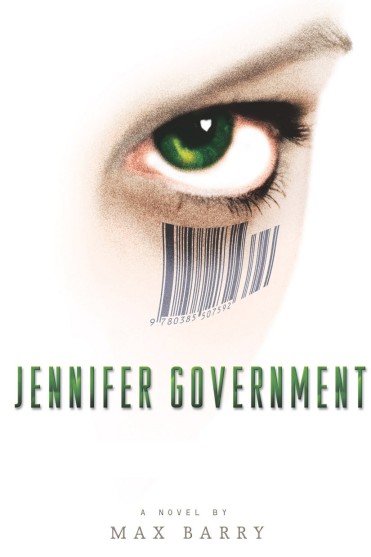
I thought about this when I heard about H.R. 683: the Trademark Dilution Revision Act, which was passed by the U.S. House of Representatives last year and is now headed for the Senate. The most interesting part of this bill—to me, at least—is that it may make it illegal to use trademarked names in fiction. So I might henceforth be unable to publish a novel like Syrup (which is set partly within Coca-Cola) or Jennifer Government (which features Nike, McDonald’s, and others).
Many people seem to think that’s illegal already. When I was writing Syrup, I was often told it would never be published until I took out all the real company and product names. I remember one guy in particular telling me the “Golden Rule” of fiction writing: “Never use a Coke can as a murder weapon.” Because, apparently, Coke would descend on you with an army of lawyers. You could only get away with it, he said, if you used the product in a positive way—for example, your hero loves drinking Coke. But he doesn’t use it to kill anyone.
This sounded ridiculous even at the time. I wasn’t pretending that my novels exposed actual events that had taken place in Coke or Nike; I was just using them as a setting, in the same way I used Los Angeles and Melbourne. I could have invented fictional companies, just as I could have invented fictional cities, but then I’d also have had to work in descriptions and history to build up in your head the kind of company or city I wanted you to see. Coke, Nike, L.A., and Melbourne were all convenient shorthand.
And sure enough, I didn’t have any legal issues in the U.S. with either Syrup or Jennifer Government. In both cases the publisher wanted a legal disclaimer pointing out that they were works of fiction and not based on real events, but that was it. We were never contacted by any company and never sued.
(Things were different in the UK, where free speech laws are weaker. Syrup has never been published there, and the publisher got more and more worried about Jennifer Government the closer we got to publication. Eventually they got a whole bunch of lawyers together to come up with a legal strategy, and this was: wait six months and see if anyone sues the American publisher first. If you had gone to law school for six years, you too might be able to come up with brilliant tactics like this.)
Part of the reason Syrup and Jennifer Government were able to be published was trademark law. This allows one company to sue another if they think they’re using a confusingly similar name or logo; in essence, the goal is to prevent customers from being deceived by imitators. But that’s all: the law contains a specific clause—a clause that H.R. 683 will rewrite—denying companies the ability to block non-commercial uses of their name, such as when it’s incorporated into a novel.
The current situation is exactly as it should be. I don’t believe I should be allowed to deliberately make up lies about companies and pass them off as the truth, nor start selling my own brand of sneakers called “Nike.” But if I’m writing a novel about cola marketing, why should I have to pretend that Coke and Pepsi don’t exist? Companies have made themselves loud, intrusive parts of society; why should artistic depictions of the world have to scrub out any unsanctioned mention of them?
But this is exactly what companies want. They spend billions of dollars to get their names on our lips and their logos in our eyes, but letting us talk about them is dangerous: we might say something they don’t like. They want what Naomi Klein calls the “one-way conversation:” to be able to speak to us—endlessly so, through billboards and television and radio and product placement in your movies and the back of your bus ticket—without allowing us to speak back. Unless, that is, we’re saying positive things about them; unless we’re “on message.” And so they seek complete control over their names, to ban us from uttering them unless it is to speak praise.
Companies used to be pieces of parchment. Then they gained more rights and more protections until they had the legal status of a person; you can now be sued for defaming them. But that’s not enough—of course not; nothing will be enough so long as their inbuilt goal is to endlessly expand. So now they want to be more than a mere person. They want the kinds of rights that have previously been reserved for the superhuman. They want to be gods.
Note: There are some interesting articles on H.R. 683 at Public Knowledge, Ars Technica, and Public Citizen.